Other Tibetan Language Materials
International Orders: Email TLI before placing order so as to determine the cost of shipping.
Tibetan Language Learning Materials Other Resources Helpful Background Reading
![]() |
Basic Grammar of Modern Tibetan (Tashi) Grammar textbook of spoken Tibetan is based on 12 years teaching experience at the Library of Tibetan Works and Archives, Dharamsala. It presents colloquial Tibetan grammatical structures in useful sentences with a wealth of vocabulary. The techniques for writing Tibetan alphabet are included. |
$12.00 | |
![]() |
Essentials of Modern Literary Tibetan: A Reading Course and Reference Grammar (Melvyn C. Goldstein, Gelek Rinpoche, and Lobsang Phuntshog) "Half of the words are read by implication." This Tibetan saying explains the main difficulty Westerners face in learning to read Tibetan fluently. This book will allow beginners to understand the logic of Tibetan grammar and syntax through graded readings and narrative explanations. The large glossary contains particles and is indexed by page--serving as an invaluable reference grammar for readers of Tibetan at all levels. The reading course includes a wide range of modern literary styles from literature, history, current affairs, newspapers, and even communist political essays. This book provides a very good course in modern literary Tibetan. Cassette tapes to assist students learning on their own are available through Case Western Reserve University's Center for Research on Tibet. "This [grammar] will make the study of written Tibetan a lot easier and more pleasant than it has been up to now." James A. Matisoff, university of California, Berkeley. |
$60.00 |
|
![]() |
Fluent Tibetan Course: A Proficiency-Oriented Learning System. Novice and Intermediate Levels (William A. Magee and Elizabeth S. Napper, Jeffrey Hopkins) The most systematic and extensive course system available in spoken Tibetan language, Fluent Tibetan was developed by language experts working in conjunction with indigenous speakers at the University of Virginia. Based upon courses for diplomats needing to learn a language quickly, the method acquaints students with the sounds and patterns of Tibetan speech, through repetitive interactive drills, enabling the quick mastery of increasingly complex structures, and thereby promoting rapid progress in speaking the language. The package consists of textbooks and MP3 disks (26 hours), arranged in fifteen units. The first three units are devoted to recognition and pronunciation of the Tibetan alphabet and its combinations in syllables and words. With unit four, vocabulary and grammatical patterns are introduced in situational dialogues. Each dialogue is followed by extensive drills repeating the vocabulary and grammatical patterns in different contexts thereby teaching how to use the language creatively. The exceptionally clear voices in the dialogues and drills are both male and female indigenous Tibetans. The glossary is both Tibetan-English and English-Tibetan.
For those interested in Fluent Tibetan and 18 cassettes (instead of the MP3 disks), contact TLI. (The price is $150).
|
$165.00 |
|
![]() |
How to Read Classical Tibetan: Summary of the General Path, Vol. I (Craig Preston) Do you hope to read Classical Tibetan? If you know how to read the Tibetan u-chen script and can recognize words, How to Read Classical Tibetan will show you--at your own pace--all the relationships that make Tibetan easy to read. It is a complete language course built around the exposition of a famous Tibetan text on the Summary of the General Path to Buddhahood written at the beginning of the 15th century. Each chapter starts with a successive portion of the text, which is then analyzed grammatically and translated with comments. This is a particularly good format for self-study as it is like having a teacher explain the text in detail. For the advanced students, the author has included an additional text at the end of each chapter. Because everything is always explained in every sentence, you will easily learn to recognize the recurrent patterns, making the transition from learning words to reading sentences much easier for you. As you study this book, you will learn to recognize the syntactic relationships you encounter, understand the meaning signified, and translate that meaning correctly into English. |
$39.95 |
|
![]() |
How to Read Classical Tibetan, Vol. 2: Buddhist
Tenets, (Craig Preston)
How to Read Classical
Tibetan, Volume Two: Buddhist Tenets continues Craig Preston's ground-breaking series of self-study materials
designed for students learning to read Classical Tibetan on their own. This
book serves a dual purpose: the student learns both grammar and philosophy at
the same time. |
$45.00
|
|
![]() |
Manual of Standard Tibetan: Language and Civilization (Nicolas Tournadre and Sangda Dorje) This study course, which consists of forty-one lessons, provides very good study material for the beginning- and intermediate-level students of the modern language. Each lesson starts with a dialogue and translation. Further vocabulary and examples are then given to cover the lesson's grammar aims. Audio recordings of the dialogues on two CDs come with the book. If you want a good course in modern Tibetan, this book should be high on your list. "The Manual of Standard Tibetan is the best resource available for teaching modern spoken Tibetan bar none. Its grammatical explanations are precise, detailed and clear, while its dialogues and surrounding text are rich with authentic cultural information on the social contexts in which Tibetan has meaning. It should quickly become the standard textbook in the area."--David Germano, The University of Virginia Nicolas Tournadre, a leading linguist and Tibetologist, is Associate Professor in the Department of Languages at the University of Paris VIII. He also teaches Tibetan at the National Institute of Oriental Languages and Civilizations. |
$80.00 |
|
![]() |
A Primer for Classical Literary Tibetan, Vol 1 (Grammar) and Vol. II (Reader) (by John Rockwell, Jr.) This is the second edition of the popular "Primer for Classical Literary Tibetan, which was released in 1985 and, due to its instant popularity, subsequently spread around the world via a spontaneous Xerox lineage. Divided into two volumes, this primer covers all aspects of Tibetan literary grammar in a step by step approach, with reading exercises to complement each lesson. Volume I includes 18 lessons, while Volume II contains short readings meant to enhance the student's understanding of the grammar. Written by John Rockwell, "A Primer for Classical Literary Tibetan" will be a great resource for all students attempting to learn literary Tibetan. |
$55.00 |
|
![]() |
Thunmi Gong Ter, Verb Dictionary This book makes dealing with the Tibetan verb much easier as it has an index in which nearly every Tibetan verb form is found. This guides you to the main section of the book which lists all four forms of each verb with a definition in English and Tibetan. An indispensable book for reading classical Buddhist texts. Highly recommended. |
$23.00
|
|
![]() |
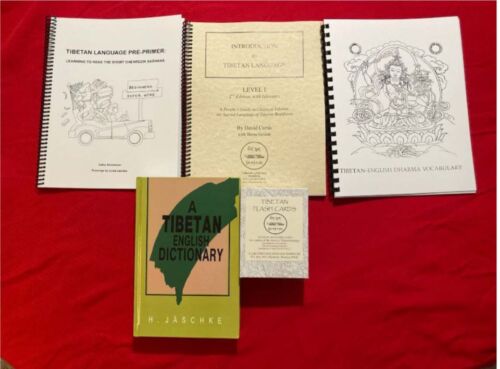
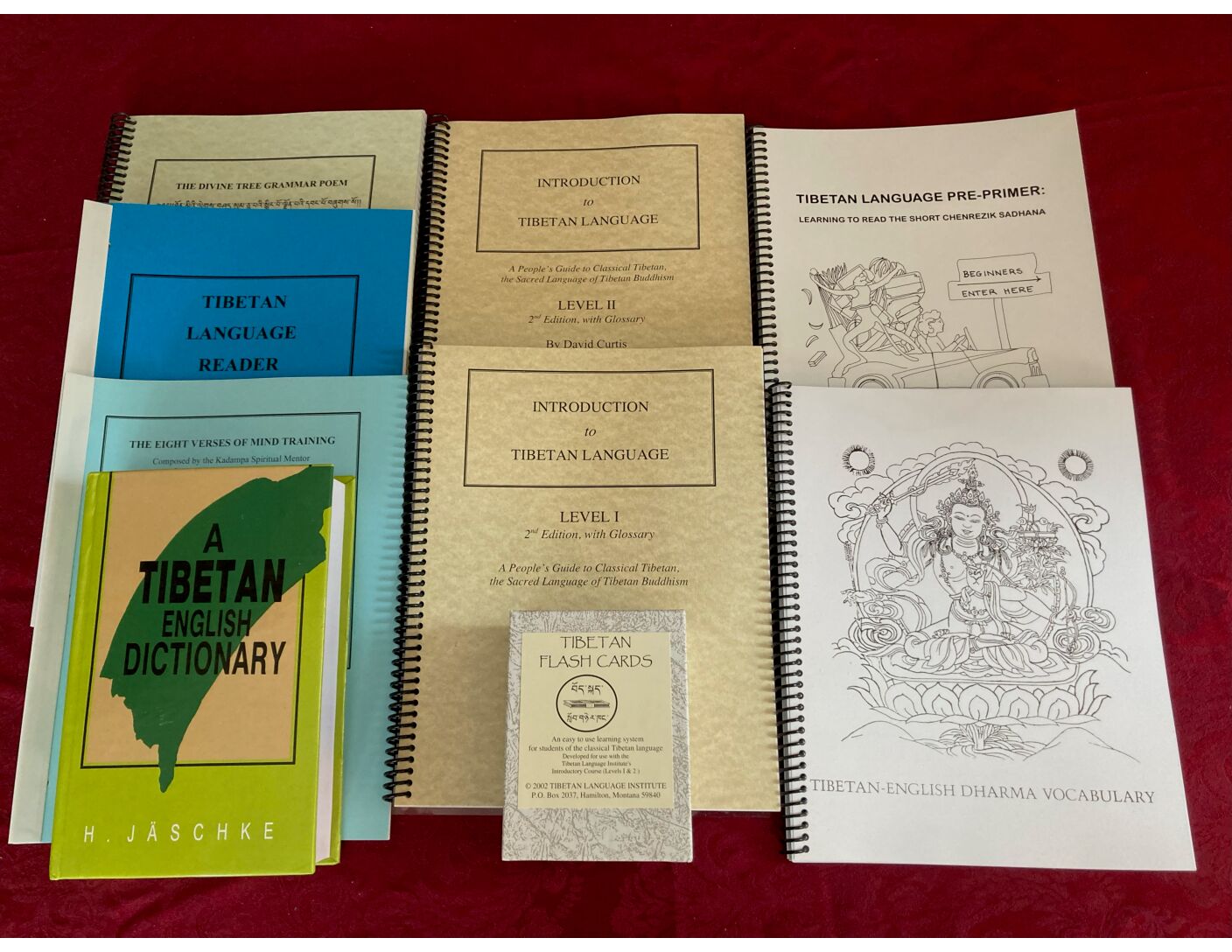
Tibetan Language Pre-Primer: Learning to Read the Short Chenrezig Sadhana (Dr. Cathy Kielsmeier) Are you interested in learning to read Tibetan, but don't know where to start? Have you been frustrated by the lack of availability of very easy, very basic instructional materials? Here's a book that has been specially developed to meet your needs. Tibetan Language Pre-Primer fills a gap in currently available instructional materials. It will introduce you slowly and effectively to foundation "pre-primer" skills. Using this book, you will do the following:- Learn the Tibetan alphabet - Learn how Tibetan words are made from the letters - Learn how a Tibetan-English dictionary is organized - And learn to read the short Chenrezig sadhana in the process!Tibetan letters and words are structured quite differently from those in Western languages, and detailed instruction is needed before learning to read the language. This book will teach you the specific skills you need in an organized, sequential fashion. You will then be well prepared to study other books and materials which specialize in teaching reading. Multiple examples for every new concept are given, followed by related exercises (with their answers on the same page). Material is not overly grim and serious, but has a lighthearted approach that helps make learning fun. As you learn each new step, it is immediately meshed with learning to read the short Chenrezik sadhana. All examples and vocabulary are drawn from that sadhana so that you will have constant repetition and reinforcement. By the time you have completed this book, you will know all the words in Chenrezik, thus greatly increasing your pleasure and understanding of it. |
$20.00 |
|
![]() |
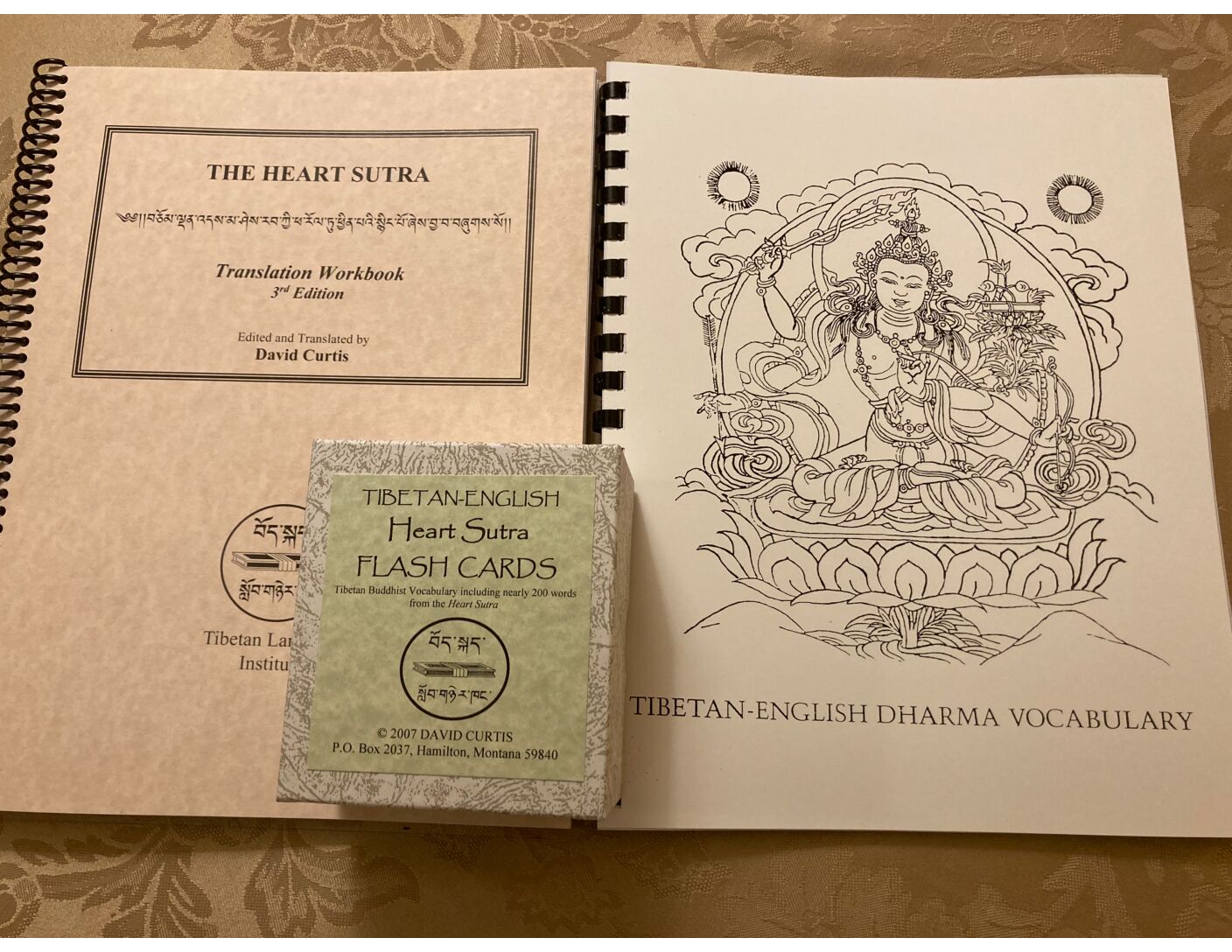
Tibetan-English Dharma Vocabulary (V.V. Kalu Rinpoche) This book offers to acquaint students with the vocabulary most often encountered in the Tibetan tradition of oral and written Dharma. The words are defined in terms of their Dharma context and many are given their Sanskrit equivalencies. Many line drawings. Two appendices: The Eight Auspicious Symbols and the Tibetan Alphabet and the Seven Elements of Tibetan Letter Combinations (written in U-chen and U-may plus phonetics) An example of listings: Mind; The Buddha, the Four Noble Truths, and the Path; Right Mindfulness; the Six Consciousnesses; The Ten Universal Fetters; Practice; Vows; Degrees of Spiritual Realization. This is a veritable treasure trove of essential information. (Published originally in 1984) |
$15.00 |
|
![]() |
Tibetan Sadhana Vocabulary: Translated Words of Seven Buddhist Sadhanas (by Dr. Cathy Kielsmeier) Would you like to understand the Tibetan words in your Buddhist Sadhana? This book is a guide for beginning to develop a sadhana vocabulary, an easier task than you might think. Based on a count of all the words in seven well known peaceful sadhanas, you will find that only 150 words are found in many of them - that's a manageable number to learn! If you want to learn the words in all seven sadhanas, there are only about 600 more. Or, you can quickly select out words from your favorite sadhana, even just the words in its visualization section. Remembering these words will be easy, as you will use them every time you practice. To facilitate efficient learning, words from the Chenrezik, Medicine Buddha, Green Tara, and Ngondro's Refuge, Vajrasattva, Mandala, or Guru Yoga sadhanas were counted as either frequently used, less used, or rarely used. Also included is a very useful Tibetan-English index, English-Tibetan index, and appendices (the Tibetan alphabet, finding the root letter, prefixes etc, organization of the Tibetan dictionary, and a list of verbs and tenses from the sadhanas). |
$24.00 |
|
Tibetan Verb Lexicon: Verbs, Classes, and Syntactic Frames (Paul G. Hackett) This is the first Tibetan-English verb resource to be published in more than thirty years. It is a verb dictionary containing extensive lexical information. Much more than a mere translation of existing works, this lexicon was compiled employing statistical techniques and data, and draws on sources spanning the 1200 years of Tibet's classical literature and covering all major lineages. |
$29.95 |
||
![]() |
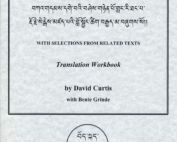
Translating Buddhism from Tibetan An introduction to the Tibetan Literary Language and the Translation of Buddhist texts from Tibetan"", by Joe B. Wilson. A brilliant book. Agent reference manual . Written for beginners, but with material of interest to advanced students as well. Highly recommended for the student serious about reading Tibetan Buddhist texts. 772 pages. Hardback. |
$65.00 |
|
Translating Buddhism From Tibetan Tape Read by Venerable Tsering Namgyal of Namgyal Monastery Institute of Buddhist Studies. Accompanies the book by Joe B. Wilson |
$10.00 |
Articles written by David Curtis
Books with English and Tibetan
Colloquial/spoken Learning Materials
Free Items
Learning Tibetan with TLI
Print Dictionaries
Rangjung Yeshe Tibetan-English Dictionary of Buddhist Culture Version 3
Electronic Tibetan-English Dictionaries from TCC
Tibetan Computer Company Translation Software
Tibetan Learning Materials published by TLI
![]() |
Among Tibetan Texts: History and Literature of the Himalayan Plateau E. Gene Smith ran the Library of Congress' Tibetan Text Publication Project of the United States Public Law 480 (PL480)--an effort to salvage and reprint the Tibetan literature that had been saved by the exile community or by members of the Tibetan-speaking communities of Sikkim, Bhutan, India, and Nepal. Smith wrote prefaces to these reprinted books to help clarify and contextualize the particular Tibetan texts: the prefaces served as rough orientations to a poorly understood body of foreign literature. Originally produced in print quantities of twenty, these prefaces quickly became legendary, and soon photocopied collections were handed from scholar to scholar, achieving almost a cult status. Among Tibetan Texts collects these essays, presenting them together for the first time. The essays span a vast range of Tibetan literature, covering Buddhist texts from all lineages, histories, biographies, and literary arts. They provide historical context for the origins of various traditions, with helpful lineage charts and overviews of the literature and the great figures that shaped those traditions. The impact of Smith's essays on the academic study of Tibetan literature has been tremendous, both for their remarkable ability to synthesize diverse materials into coherent accounts of Tibetan literature, history, and religious thought, and for the exemplary critical scholarship Smith brought--and continues to bring--to this field. "Gene Smith opened more doors to Tibetan Buddhism than any scholar of the 20th century. These essays are the keys."--Prof. Donald Lopez |
$39.95 |
|
![]() |
Nalandakirti Journal (Karma Sri Nalanda Institute, #1 1989) Introduction by H.E. Jamgon Kongtrul Rinpoche. Essays include: "The Torch that Clarifies the Essentials of the Ocean of Views" (Khenpo Tsultrim Gyamtso Rinpoche); "On the Meaning of the Three Turnings of the Wheel of Dharma, Showing that They Are Not Contradictory" (Khenchen Thrangu Rinpoche); "A Concise Analysis of Differing Approaches to Reality" (Khenpo Chodrak Tenpel); "Shentong: The Tathagaragarbha Sutras and the Buddhist Notion of Self" (Susan Shenpen Hookham); and the translation "The Buddha, the Dharma, the Sangha: A Selection from Jamgon Kongtrul I's commentary on the Mahayanaottaratantrasastra by Maitreya through Asanga" (Kiki Ekselius and Constance Wilkinson). |
$7.00 |
|
![]() |
Shambhala Dictionary of Buddhism and Zen Over fifteen hundred entries. An excellent reference work designed as a tool to help familiarize readers with Buddhist terms and concepts encountered in the study of Buddhism. The lives and teachings of important philosophers and meditation masters, practices, texts and scriptures, and the range of sects and school. Pronunciation tables and a comprehensive bibliography |
$20.00 |
|
![]() |
Tibetan Literature, Studies in Genre Essays on a wide variety of topics having to do with the entire history of Tibetan literature written by foremost scholars. Topics include History and Biography, Canonical texts, philosophical literature, ritual and more. 549 pages. Hardback |
$29.95 |
|
Tibetan Language Institute PO Box 2037 Hamilton, Montana 59840 USA 406.961.5131
Executive Director: David Curtis
|